
The problem, stated plainly
Autonomy in contested environments has a dependency problem, and it starts with a single platform, not a swarm.
A drone or satellite acting on its own sensors has to decide, continuously, whether a reading reflects the world or an attack. Today that decision comes from one of two places: hard-coded thresholds set before the mission, or information from somewhere else — a ground link, a peer, a GPS signal. Both fail exactly when they matter. Fixed thresholds can’t tell a violent-but-real environment from a quiet-but-fake one. External references are the first thing jammed or spoofed. The root cause is the same in both cases: the platform doesn’t know what it doesn’t know, so someone or something else has to know it for them.
Nervous Machine is built on the opposite premise. Each platform learns a causal model of its environment from its own sensors, and every relationship in that model carries a certainty score that is earned through validation against reality — never assumed, never transferred. The part that matters for defense: the model’s unexplained variance is itself measured. The platform has a live, quantitative answer to “how blind am I right now, and where?” That is what lets it act alone, degrade honestly, and treat anything arriving over a link as a hypothesis to check rather than truth to swallow.
That’s the claim. Claims are cheap. So I stress-tested it on real data, against the sharpest questions I’ve gotten from the defense side:
Does a platform’s local judgment hold up alone, long enough to matter, when the peer-to-peer link is exactly what gets jammed?
If one platform is spoofed, does it earn certainty on the lie and propagate it to the fleet as ground truth?
Can a fleet distinguish a localized anomaly from a fleet-wide environmental one — without depending on the network staying up?
None of these is answered by more airframes or more simulation. They need real physics, real sensor faults, and a real adversary-grade environment.
The dataset
ESA’s Swarm constellation: three satellites, launched 2013, each carrying an absolute quantum magnetometer and a classical fluxgate. I ran May 2024 — which happens to contain the G5 “Gannon” superstorm, the strongest geomagnetic event in two decades. Space-weather driver context comes from NASA’s OMNI solar-wind stream, the broadcast every platform in orbit already receives.
Two properties of this constellation make it an unusually honest testbed:
It’s a heterogeneous force, not three identical nodes. Swarm-C’s quantum magnetometer failed in 2014; in 2024 it flies on its classical fluxgate alone. So the “fleet” is two quantum platforms and one classical — a mix of systems, which is what any real force looks like.
Two of the satellites, A and C, fly as a co-located pair about 155 km apart — a quantum sensor and an independent classical sensor measuring the same patch of field at nearly the same time. After removing the main field, their residuals agree to about 1 nT at native resolution. That agreement is physics, not a model, and it becomes the fleet’s sharpest tool.
All attacks below were injected into this real data after trust was earned, with the learning kernel unmodified between tests.
Test 1: one platform, no fleet
Question 1 first, in its purest form: strip the fleet away entirely. One satellite (Swarm-A), gating on its own quantum magnetometer against its own model of the world — a public reference field, two small correction maps it built for itself during its first nine days, and the quiet OMNI broadcast. Nothing from a neighbor.
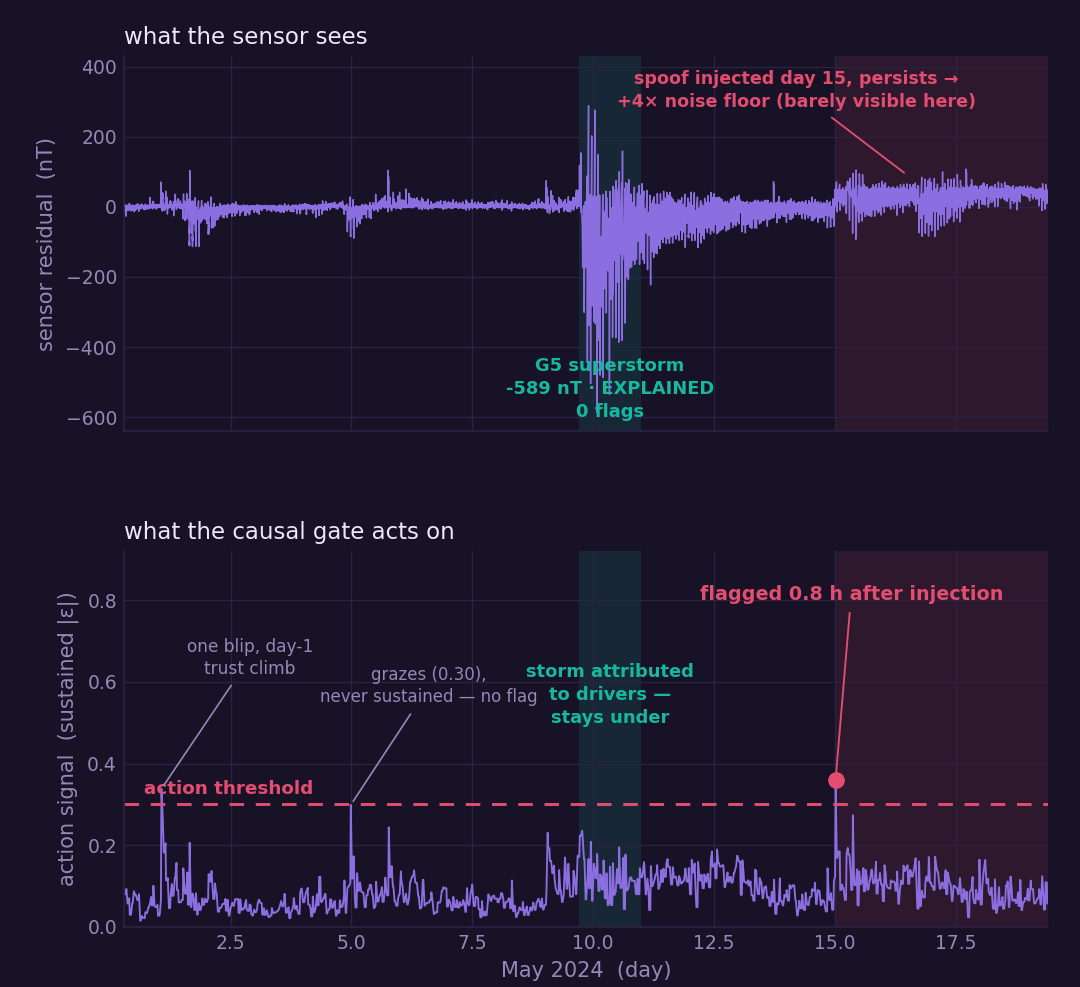
The storm. During the superstorm, the sensor’s deviation from the reference field swung to nearly 600 nT — roughly fifty times the quiet floor. Any fixed threshold dies here: it either flags the entire storm as an attack or is set so loose it catches nothing. The causal gate raised zero flags through the entire storm, because its learned driver relationships explained the swing: the environment is violent, and here is why. Over 19 operational days: zero steady-state false actions, with one blip during day one’s certainty climb (*no earned prior used for this test).
The attacks:
A hard hijack at four times the noise floor, a signal thirteen times smaller than the storm the gate just sat through, was flagged in 0.8 hours.
The same lie injected into both onboard magnetometers identically, the attack a redundant-twin check is blind to by construction, also caught in 0.8 hours. The gate compares the sensor to the world, not to its twin.
Integrity jamming collapsed the earned certainty, and the platform flagged its own blindness in 10.6 hours. Known blindness, not silent blindness. The platform reports that its confidence is gone rather than acting on degraded belief.
Lies gentle enough get absorbed by the gate, not made invisible — the raw error signal stays logged as forensics; the gate governs what earns an action, not what gets seen. The silent envelope is measured — steps under ~5 nT, drifts under ~8 nT/day — bounded at roughly a 100 nT ceiling, ever, and taxed on exit. And an attack timed inside the storm’s widened tolerance rides free of the local gate. Hold that thought; the fleet test addresses it.
So: local judgment holds alone, against both the environment and the attacker, with a measured and bounded blind spot. Now add the fleet.
Test 2: three platforms
Fleet coordination is usually framed as the hard part, and it is hard — but only because of what each node brings to it. A fleet of platforms that can’t judge alone just aggregates confusion faster. The design decision under test here: coordination is advisory and downstream of each platform’s own judgment, never a gate on it. Every node acts on its own sensor against its own model; the fleet layer is how they compare notes, in ~120-byte signature vectors, whenever a link happens to exist.
Storm vs. spoof (question 3). When the G5 hits, all three platforms’ residuals swing hundreds of nT — but they swing together, the shared solar-wind driver explains each of them, and the co-located A/C pair stays locked to its ~1–2 nT physical envelope. Verdict: environmental, zero nodes flagged. Now spoof one node: its reading goes unexplained by the shared driver and it departs its co-located twin by 44× the physical envelope. Verdict: localized to that node; fleet safe elsewhere.
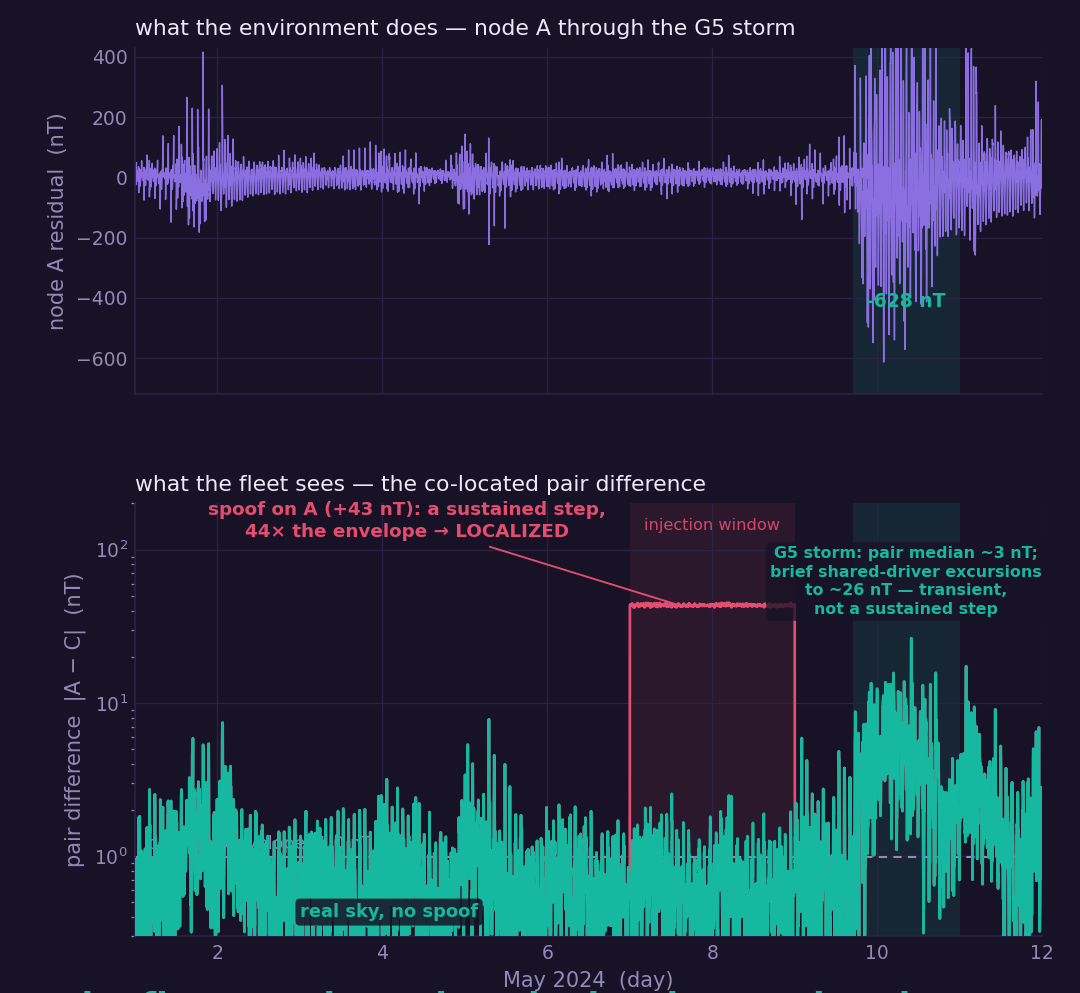
There’s a structural point buried in that result. The local gate is deliberately built to absorb slow, sustained deviation — that’s the price of not panicking on noise. But the co-located pair difference is model-free: it doesn’t absorb anything, and it carries no earning delay or persistence rule. The fleet layer catches exactly the sustained lie the individual node was designed to let slide. The two layers cover each other’s designed weaknesses, which is what defense-in-depth is supposed to mean and rarely does.
Measured on the real A/C pair, that division of labor comes with numbers. On the acute 4× spoof, the pair prior alarms in about a minute — the lie is a 44σ departure the instant the two nodes are compared — versus the local gate’s 0.8 hours. Faster, but that’s the least valuable win: the local gate already catches acute attacks, and does it with zero comms. The real win is catches at all. A 5 nT spoof — inside the solo platform’s silent envelope, never flagged locally — is a 5σ pair departure, alarmed in about a minute. A 3 nT spoof: about six minutes. The slow 5.4 nT/day walk the local gate is built to absorb crosses the pair alarm at +8.7 hours, roughly 2 nT into the lie. Net effect: the fleet shrinks the attacker’s silent envelope from ~5 nT (node alone) toward ~3 nT, and closes the sustained-drift channel entirely — while connected.
Three caveats keep that honest. It’s the A/C pair only; B has no twin, so B’s coverage is the shared driver and cross-plane corroboration, which is looser. It needs comms: jam the link and the node falls back to its local 0.8-hour gate and ~5 nT envelope — degraded, not collapsed, which is the point of local-first. And a coherent spoof of both A and C with the same offset defeats the pair — the exact cost-ladder rung where the attacker must corrupt C specifically. One design note for precision: the fleet layer is advisory, so a pair alarm is an earlier and broader warning (”watch node A”), not an earlier autonomous action; action rests on the local gate by design.
That said, there’s a configurable middle ground between advisory and gating, and it’s an operating-point choice rather than an architecture change. A sibling’s warning can be allowed to tighten the local gate’s sensitivity on the named edge — cued detection: a warning raises the prior probability of attack, and the correct response to a higher prior is a lower threshold on that specific hypothesis. The critical property is that a warning changes where a node looks, never what it believes. Any flag that results is still earned entirely from the node’s own error signal against its own sensor, so the poisoning channel stays closed. The price is honest and bounded: a lower threshold lets more noise into the trigger, so a forged or spammed warning can induce false flags — nuisance, not compromise. Three guardrails keep it nuisance: cued sensitivity is additive and time-boxed, able only to raise scrutiny on the named edge before decaying back to baseline; cued flags don’t propagate, since only sensor-earned flags generate outbound warnings, which breaks any cry-wolf cascade; and warnings are attributable, so a node whose warnings never corroborate becomes an anomaly signal in its own right. In the framework this lives in each node’s prior configuration — a mission picks its own point on the earlier-catch versus false-alarm curve, per edge, before launch, and can pick differently for a co-located pair than for a lone platform.
The cost of a multi-node attack. Each node the attacker corrupts forces one more independent discriminator. Spoof one node → the pair prior localizes it. Spoofing A and B doesn’t help, because C is still A’s honest twin; the attacker must corrupt C specifically to blind the pair — and even then, the third orbital plane, the quiet broadcast, and the within-node sensor cross-check remain. Spoof all three coherently and the lie must now be sustained, physically self-consistent across platforms and sensor types, and accompanied by a forged solar-wind broadcast, because a real environmental event is driven by something measurable. That is the honest epistemic limit — and it is a very different price than “inject one bad reading.”
Does a spoofed node poison the fleet? (question 2 — the one that got pressed hardest.) This is the whole game. If a compromised machine earns certainty on a lie and the fleet ingests it as ground truth, the assurance layer is worse than nothing. So I groomed a node into a lie — walked it slowly until its own weights absorbed the false signal — and had it emit that groomed signature to a peer. Then I ran the worst case: I force-fed the peer the corrupted weights as its starting belief. The peer shed 93% of the lie, re-earning certainty against its own sensor, which didn’t corroborate it. This isn’t a filter that recognized the attack; it’s the architecture: certainty never transfers between platforms. It is always re-earned locally, against local reality. A groomed signature arrives as a hypothesis to check — never as truth.
Under jamming (question 1, fleet edition). Local detection fired at the same 0.8 hours whether the peer exchange was full, intermittent, or fully cut — as it must, since detection is a purely local property: the node’s own sensor against its own model, untouched by the comms regime. Jamming never delayed detection — it only delayed resolution: a jammed node still knows it has an anomaly; it just can’t yet classify it as local versus fleet-wide. The ~120-byte signature re-expands the shared picture the moment any intermittent window opens. The fleet degrades to independent local judgment with a defensible verdict on every node, then re-converges when a link returns.
Known limits
The local model predicts only about a quarter of the storm’s swing; the rest is tolerated via broadcast-conditioned scaling, not explained. Tolerance is not prediction. Worth situating, though: that quarter was learned from nine days of self-calibration, cold. The driver data to do better exists — years of space-weather history of the kind the Space Atlas work trains on — and a prior trained on it would raise the prediction floor and shrink the tolerated remainder. It’s a real limitation of this run, not a ceiling of the approach; I didn’t train that prior here, so I don’t get to claim the number it would produce.
A spoof timed inside a storm’s widened tolerance evades the local causal gate. The per-node sensor cross-check — which does not widen with the weather — is the remaining tell, which is exactly why it’s kept as always-on forensics, and why Swarm-C’s dead quantum sensor is a real gap on that one node.
This is a stress-test on satellites, not drones. The co-located pair is a stronger physical prior than a generic swarm has — though formation-flying platforms often have an equivalent, and any pair of platforms measuring the same field enjoys some version of it.
Why this matters for assured autonomy
The result that generalizes is not any single detection time. It’s this: the quiet floor on each platform is not a constant of nature. It is the frontier of that platform’s causal model — the variance it hasn’t explained yet. I watched it fall from 21 to 15 to 11 nT as the model earned structure. Every causal relationship a platform validates — attitude, its own actuators, thermal state — moves variance from “noise” to “explained,” and the attacker’s silent envelope shrinks with it.
That inverts the usual security posture. The learning loop isn’t a capability bolted next to the assurance story; it is the assurance story: a platform’s silent-attack budget equals the unexplained variance of its model, and it decays as the platform learns. Simulation can’t produce that number, because a model that never measures its own error against reality can’t quantify — let alone shrink — its own blind spot. This is what “knowing what you don’t know” means when it’s an engineering quantity instead of a slogan: hard-coded thresholds and external references become fallbacks rather than load-bearing dependencies.
One more thing these numbers understate: everything above ran from a cold start. The platform built its model from scratch — nine days of self-calibration, a day-1 certainty climb that produced the single blip, a quiet floor that opened at 21 nT. The fresh prior is the hardest configuration. A fielded system wouldn’t start there. Causal structure that has proven stable on one mission ships as the starting prior for the next, so a new platform begins with a smaller unexplained variance, a smaller silent envelope, and a shorter trust climb. And the poison test is precisely what makes that inheritance safe: a transferred prior arrives the same way a peer’s signature does — as a hypothesis, with certainty re-earned against the local sensor. Good priors accelerate; wrong ones get shed. The same mechanism that stripped 93% of a groomed lie protects a new mission from an inapplicable inheritance.
And it answers the fleet question the same way. Coordination is hard precisely because each node’s trustworthiness has to be established before the network, not by it. When every platform carries calibrated self-knowledge, the fleet layer can stay what it should be: advisory, kilobyte-scale, jam-tolerant, and structurally unable to launder one machine’s lie into another’s ground truth.
This is real ESA and NASA data. A real superstorm. Every configuration knob is legible, and every gap named. If you work on assured autonomy, quantum sensing, or the integrity of the signals autonomous systems act on — I’d like to compare notes.