
Somewhere in Mars’s 2024 dust-storm season there is an error two humps wide. For a few weeks in late February, and again across May and June, Curiosity’s detector measured five to six micrograys per day less radiation at the surface than any model of ours predicts. Something was suppressing the dose at Gale Crater, and the model cannot validate the driver.
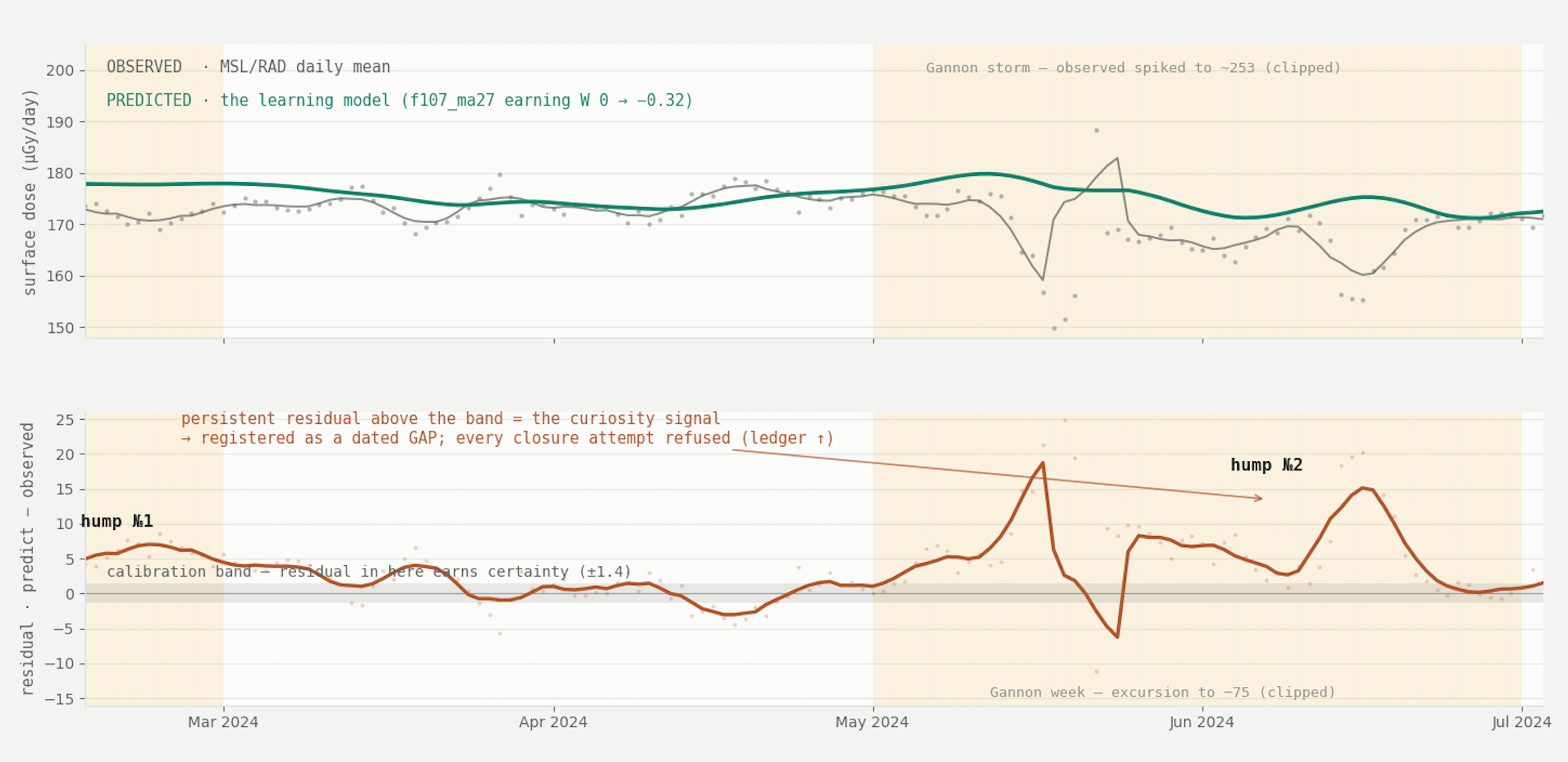
This piece is about what it took to corner the error, name it, and hypothesize what measurement would validate the driver. The gaps in the chart above are exactly where the model lacks the signal to learn. Because our Mars data is honestly sparse, certainty is hard to earn here. However, we are able to isolate the drivers we know from the ones we can’t yet validate. In other words, we know what we know and what we still need to learn.
Our agent took 43,044 radiation measurements from MSL/Curiosity’s RAD detector across a full Mars year of 2024–2025 solar maximum, pulled from NASA’s public archive and assembled voxel by voxel across three pre-registered learning windows. The humps live in the dust-season slice at 13,861 observations, January–July 2024. The agent stopped after cycle nine, but not because it ran out of compute. It ran out of data it could honestly learn from. That ending defines the search space.
The rules of the game
The agent is autonomous but bound to some fixed structure. (Similar to how I make my own choices but can’t circumvent my genetic makeup). A frozen learning law that earns per-edge certainty only from prediction error, a causal graph seeded from a domain prior, and one hard discipline — every hypothesis, threshold, and scoring rule is committed before the data it will be scored on is fetched. The search space predates the telemetry. The gap is known before the candidate ranking runs.
No parameter was tuned to make a result look better. The learning law never changed. The only per-domain knob is a declared error scale, set by a scale test on a leading calibration slice and frozen as its own dated commitment before the learning pass (k = 4, re-verified independently on each new window).
What the agent learned
The agent discovered real, textbook physics entirely on its own. We intentionally hid the direct cause-and-effect relationship between solar activity and Mars surface radiation. If the agent wanted to understand how the Sun affects radiation on Mars, it had to figure it out purely by making predictions, seeing where it was wrong, and adapting.
By earning its certainty through its own prediction errors, the agent correctly mapped out several complex dynamics:
Context changes everything: The agent learned that solar activity affects Mars differently depending on the planet’s orbit. During the planet’s quiet season, solar activity actually suppresses surface radiation. During storm season, it does the exact opposite. The agent figured out that the same driver follows different rules depending on the broader environment.
Solar storms act like shields: It identified that major solar events actively drive down background radiation on the surface, reacting hour by hour to incoming storms.
History matters more than the present: The AI realized that radiation levels don’t react to what the Sun is doing today. Instead, it responds to the cumulative buildup of solar activity over the past month.
The hangover effect: It correctly predicted that radiation levels stay depressed for days after a major solar event, slowly bouncing back to normal—and it locked in this prediction before it was even given the data to prove it.
The hard climb
Every relationship in the agent’s map carries a certainty score between 0 and 1. It’s a running tally of how well that relationship has actually predicted the data. Certainty is earned slowly and can be lost. And in this run, it was mostly lost.
Take the link between solar activity and surface radiation during Mars’s quiet season, when the planet is farthest from the Sun. The agent built that link’s certainty up to 0.554 across July through October — respectable, on this scale — and then November arrived, the seasonal regime changed, and the score collapsed. The same link during storm season climbed to 0.619 before the extreme days of solar events knocked it back down.
This is what honest learning looks like on a domain this thin; One detector, in one crater, with the driving solar events measured from another planet entirely. Simple day-by-day models genuinely cannot capture the extremes, and the agent never assumed they could. The certainty scores don’t just fluctuate, they fluctuate in a pattern that points somewhere. There is likely a missing driver or two threaded through the whole arc.
This is the framework’s core wager: learn what is known, and constrain to what is unknown. Mars is one of the most unknown environments we could point the framework at, which is precisely why we did. What stabilizes across nine cycles is not the weights. It’s the map. Which residual survives, at what magnitude, with what dated external dependency. That frontier is the reproducible output, and it is the one output that gets sharper every time an edge honestly collapses or refuses to learn.
What was refused
Three times, the agent pitched a hypothesis, and the framework rejected it. In a world where AI frequently hallucinates to give you the answer you want, these “no’s” are exactly what make the “yes’s” so valuable.
Cycle 1 (The near miss): The agent found a potential driver that looked promising but fell just short of our strict, pre-set threshold for certainty. Instead of lowering the bar to force a fit, the system rejected it. (Later, by adjusting the timeframe rather than bending the rules, it successfully proved this same driver).
Cycle 6 (The wrong data): The AI realized it was missing a piece of the puzzle and requested data on atmospheric pressure. We fed it half a year’s worth of surface pressure readings. The result? A flatline. The data didn’t explain the anomaly. Instead of twisting the numbers to make them fit, the agent simply discarded the hypothesis. It narrowed the search space, effectively telling us: whatever is causing this error, it isn’t atmospheric pressure, so stop looking there.
Cycle 9 (The tempting trap): The agent pulled solar wind data from a NASA satellite orbiting Mars. The data showed a highly suggestive trend—it looked like it might be the answer. But again, it didn’t quite meet the rigid certainty threshold. Despite the temptation, the AI refused to launder a marginal signal into a false fact. It was declined.
The gap register
Which brings us back to the two humps from the opening. The episodic deficit (February +5.98, May +5.30, June +5.61 µGy/day above the band) that outlasted everything else: the registered prior, two candidate timescales, five hypothesized forms, one nulled sensor, and one declined archive. They drove the whole campaign, and the final output: a request for better measurement. The agent’s ending register names exactly what would reopen the case:
A third party’s data release. The MY37 dust-opacity maps are not yet public. The agent pursued this path, but the archive probe returned 404s where the MY36 control resolves.
A mission that hasn’t arrived. ESCAPADE reaches Mars orbit in 2027; its science phase provides the first physics-grade upstream solar-wind measurement since MAVEN. Our prediction for what it will see is already registered — committed July 2026, roughly two years before first data, with directions attached. Whatever ESCAPADE measures, it adjudicates the agent’s dated hypothesis.
A research task thats first step is already on the board. Our MAVEN upstream selection was deliberately crude and declared as such; physics-grade bow-shock filtering could sharpen cycle 9’s marginal signal into an answer, either way. Cycle 10 is queued. It’s an event-conditioned re-test of the same archive. A stream-interface arrival detector with exponential recovery, the same functional form that earned its way in for proton events. If this run taught one lesson repeatedly, it’s that this domain’s physics lives in events and integrals, not instantaneous levels. Cycle 9 tested a level; cycle 10 will test the event. And the suppression reading of the humps makes this the natural suspect. A dose deficit is what transient heliospheric shielding looks like from the surface. Pre-registered before scoring, like everything else here.
One potential live explanation: our event drivers were measured at Earth. GOES sees the Earth-facing Sun; in 2024 the Earth–Mars longitudinal separation was large, and Mars saw a different storm sequence than our drivers did. Part of what the humps may be measuring is simply the angle between two planets. That hypothesis is testable in cycle 10’s Mars-local event conditioning.
A suggestion not yet in the register: Curiosity’s own Mastcam measures local atmospheric opacity (tau) at Gale, and those observations are in the PDS. A Gale-local tau series may be an admissible near-term dust test that doesn’t wait on the MY37 global maps, but it wasn’t pre-registered by the agent.
This is the point
Every learning system in the market (digital twins, world models, foundation models), fails at its knowledge boundary. Almost none can emit the boundary as coordinates, magnitude, date, and the name of the measurement that would move it forward. That emission is what turned this run from a fitting exercise into something else. Along the way the agent read the gaps and issued a collection requirement, nulled a sensor against it, tasked a future NASA mission, and refused to launder a marginal signal.
An agent that ends by saying “here is exactly what I know, here is exactly what I don’t, and here’s the shape of the search space” is doing the one thing the AI economy is currently worst at.
Knowing what you don’t know is the beginning of knowing.